

Hi, it’s Colin! Welcome to the 137 new subscribers who have joined Take Rate since the last Marketplace Memo. I am excited to have you join the 4,300+ marketplace founders, operators, and investors who subscribe. Join the fun! 👇
👋 Welcome to the 17th edition of the Marketplace Memo and first edition of 2026. My goal is to share curated news, content, and stories about marketplaces, with a splash of my own color. Please enjoy and share with others!
Power your marketplace with...

Whop Rails – Build a marketplace or platform on our global payment rails.
Built for marketplaces by a marketplace. Platforms are using Whop Rails to get the most competitive pricing, global payouts in ACH, Venmo, PayPal, & stablecoins, payment orchestration, and more! Learn what the hype is about here.
Marketplace Memo Wrapped 2025
2025 was a year of contrasts where many things were true at once. “AI marketplaces” exploded, with labor marketplaces like Mercor hitting a $500M run rate in 17 months, and OpenAI launched its own shopping marketplace features, among many other developments. Prediction market wars broke out with Polymarket and Kalshi raising billions. Meanwhile, VC funding stayed brutal for non-AI companies, and many traditional marketplaces struggled to grow. All while Craigslist turned 30 years old, essentially the same design, same model, and still humming along.
The future arrived. The past still works, and network effects are still undefeated. Many truths can co-exist.
Personally, it was a big year for me as I launched and closed Yonder’s first fund (more to come), had baby #4, and had the first full year of writing the Marketplace Memo. The first memo unexpectedly took off, growing Take Rate and re-teaching me that when you solve your own pain point, it can really resonate with others.
Where It Started and How It’s Going
First Marketplace Memo: December 13, 2024
Subscribers then: 2,265
Subscribers now: 4,326
Growth: 91% (+2,061 subscribers)
Total Memos Published: 15
Total Other Posts: 9
Total Webpage Views: 171,893
Most Popular Posts
But most importantly, a lot happened in marketplaces this year. Let's recap.
🔥 The Highlight(s)
12 Marketplaces Themes in 2025
AI created a new labor category. Among many AI labor marketplaces, like Scale, micro1, Handshake AI, and Turing, Mercor stood out and grew from $1M to $500M+ revenue run rate in 17 months as demand exploded. The new category? AI evaluation labor e.g. domain experts teaching models what “good” looks like. As always, unlocking new economic activity can lead to explosive growth.
OpenAI became a marketplace. ChatGPT launched shopping (Etsy, Shopify, Walmart integrations), a jobs platform, and app integrations with Zillow, Instacart, and Kayak. This pattern repeats with new platform adoption: aggregate attention, then capture transactions.
Prediction markets went mainstream. Kalshi raised $1B at $11B; Polymarket raised up to $2B at $9B. Now, if you can predict something, you can make a market for it.
Alternative commerce scaled. Whatnot raised $225M at $11.5B valuation, and Whop hit $2B GTV and $142M revenue, both combining tooling with marketplace distribution and showing the strength of the Marketplace+ model.
Used is the new new. Vinted broke €10B GMV and €1B revenue. OfferUp’s data shows 93% of Americans bought something secondhand in 2025. Recommerce is no longer niche and is here to stay.
The IPO window cracked open. StubHub filed (S-1: $8.7B GMV, ~20% take rate, $299M EBITDA). EquipmentShare also did an S-1 filing. This is the first meaningful marketplace IPO activity in a while outside of Instacart (2023).
AI agent marketplaces arrived. AWS, Google, Microsoft, and OpenAI all launched AI agent marketplaces. We know agent-based tools like Manus and Perplexity are reshaping how users discover and transact. AI and marketplaces aren’t competing; they’re converging as predicted. If you’re not building with agents in mind, you’re building for yesterday.
Tariffs reshuffled the deck. Temu lost up to 58% of its US daily users after the de minimis ended. Amazon dramatically pulled back ad spend. But disruption created winners: rental, recommerce, and domestic recycling marketplaces all caught tailwinds.
Airbnb went beyond stays. Launched Services in 260 cities with $200-250M investment and with 2B+ cumulative guests, they might pull it off.
Mobility’s shakeout year. Uber started throwing off cash. GM slashed Cruise. Waymo took off. Kalanick was trying to buy Pony AI. Getaround shut down US ops. Turo pulled its IPO twice before acquiring Kyte. The dust has yet to settle, and the race to AV dominance has only just begun.
Dating apps are in crisis. Spencer Rascoff joined Match as CEO. Whitney Wolfe Herd returned to Bumble, then laid off 30% of its staff, saying “dating apps feel like a thing of the past.” The category is searching for its next chapter.
Ads became the business. DoorDash ads hit $1B run rate. Amazon’s ad business continued to climb as its highest-margin segment.
It was a full year, and many of these evolutions will carry over into 2026. Now, let’s see what has been happening!
📰 News
"Boatsetter and Getmyboat announce merger, forming powerhouse marketplace for boat rentals" - The two leading boat-sharing platforms are combining to create the global leader in on-the-water experiences, with more than half a billion dollars in combined bookings across 50 countries. Michael Farb, Boatsetter's CEO since 2022, will lead the combined entity headquartered in Miami. The merger follows the classic marketplace consolidation playbook, combining inventory and demand to accelerate network effects in a category projected to reach $36B by 2032. Both platforms remain active for now as they integrate. Boatsetter

“Coursera to combine with Udemy to empower the global workforce with skills for the AI era” - Two learning marketplace giants are joining forces in a pivotal consolidation. As AI rapidly redefines skills requirements across every industry, the combined platform aims to serve the global talent market at an unprecedented scale. This is the marketplace duopoly pattern playing out, and sometimes they merge like Boatsetter/Getmyboat. LinkedIn
"Coinbase partners with Kalshi to launch prediction markets in 'Everything Exchange' push" - The crypto exchange announced it will source prediction market order flow from Kalshi, letting users trade on elections, sports, and economic indicators directly in the Coinbase app. This is the same distribution model Robinhood uses with Kalshi. The prediction market startup provides liquidity, while Coinbase serves as the front end, likely splitting fees. Fortune
“Coinbase System, updated: Stocks, prediction markets, and millions of DEX assets” - Coinbase is rapidly expanding beyond crypto into a complete financial marketplace. The future of finance is converging on single platforms that offer everything. X

“Polymarket receives CFTC approval for intermediation” - The prediction marketplace announced regulatory approval that paves the way for seamless access through registered brokers and financial institutions, and is a legitimization moment for prediction markets as they’re becoming integrated into traditional financial infrastructure. X


“Uber CEO says robotaxis are a ‘trillion-dollar-plus’ business” - Dara Khosrowshahi expects Uber to be in 10+ markets by next year, with Asia Pacific as a key growth region. Japan’s aging population creates real transportation needs beyond large cities. The company now works with 20+ AV partners, including Waymo, Baidu, WeRide, and Pony.ai. I tend to agree that Uber’s demand-side aggregation advantage will win out in the long term, as AVs become commoditized, limiting brand advantages. Business Insider
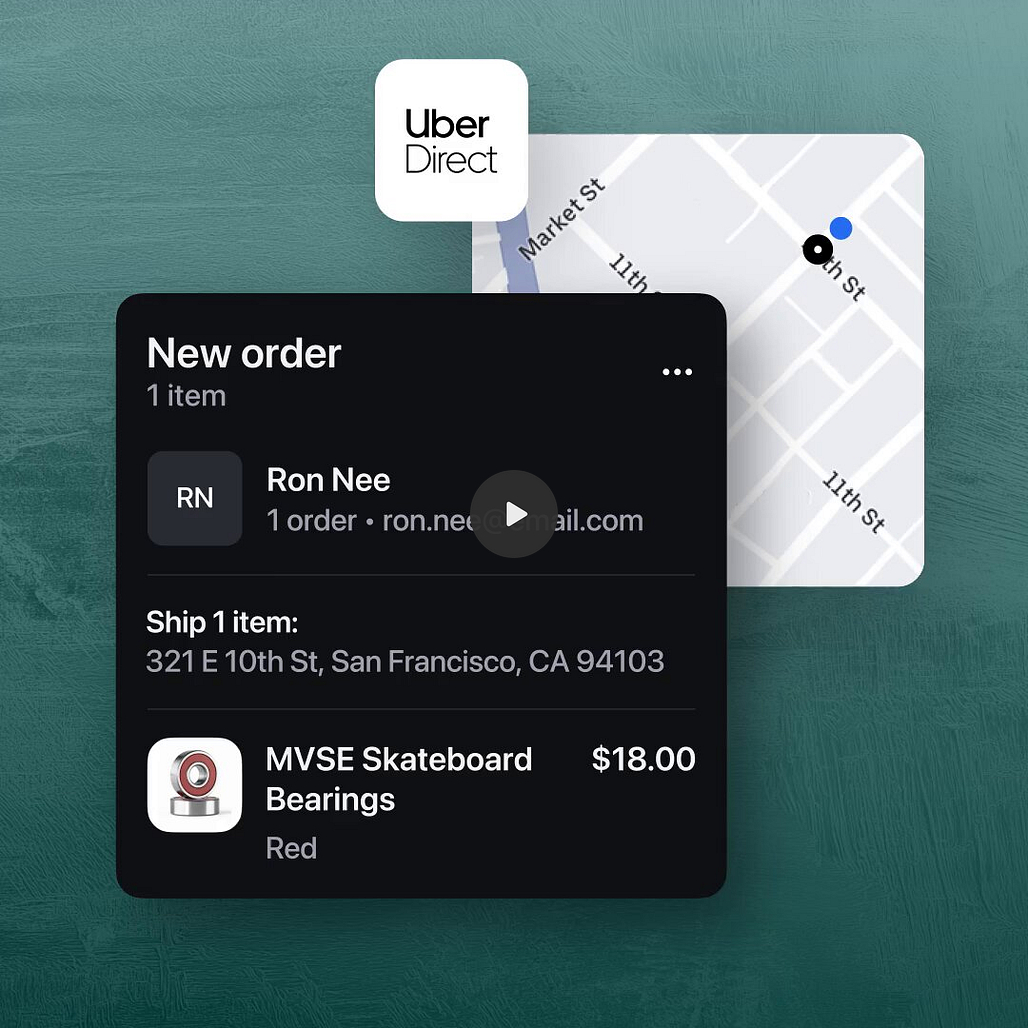
“Shopify announces Uber Direct integration for same-day local delivery” - Merchants can now fulfill online orders in-store for same-day local delivery. The integration of logistics into commerce platforms continues “because customers want your products now, not next week.” X

“Grindr goes ‘AI-first’ as it strives to be an ‘everything app for the gay guy’” - CEO George Arison is positioning Grindr to become much more than a dating app and expanding into health and wellness, travel, and local discovery. The company aims to reach $1B in revenue by leveraging its unique position as both a social product and a gay public health platform. As noted above, dating marketplaces are having an identity crisis. WIRED
"Mercor's 2025 wrapped” - The post below says it all.

“Mercor 3 years old” - Vignette on the founding of Mercor and where it is today: “Within 8 months, we scaled Mercor to a $1M revenue run rate and dropped out of college. Shortly after, we started speaking with the top AI labs, realizing we’d found our ideal customer. Mercor is now paying $2M / day to experts on our platform, with an average pay rate of $95 / hour.”

“How Palmstreet is growing millionaires—and livestreaming e-commerce” - The livestream auction platform now has 5,500+ active sellers, with 20% running full-time businesses and more than 20 sellers crossing $1M+ in revenue. One seller quit her corporate job after four months and now nets $1K-$10K per auction selling exotic plants. Inc.com

“Whop teases major product announcements across payments, crypto, advertising, and AI” - Co-founder Steven Schwartz signaled that the platform is preparing significant expansions beyond its core digital goods platform. Fresh off hitting $2B in gross transaction value and $142M in revenue, Whop continues its aggressive push to become the default infrastructure layer for internet businesses. The payments and advertising additions suggest Whop is building the full Marketplace+ stack, combining transaction infrastructure with monetization tools that lock in both supply and demand. X

“Whop becomes official payments network for micro1” - The AI data labeling marketplace is now powered by Whop’s payment rails. More partnership announcements to come. X


“DoorDash CEO Tony Xu responds to viral fake Reddit post” - A Reddit post claiming DoorDash had a “Desperation Score” to exploit drivers went viral. Xu’s response was unequivocal: “Holy fucking shit is right! This is not DoorDash, and I would fire anyone who promoted or tolerated the kind of culture described.” The post was completely fabricated, but Xu’s direct response demonstrates how marketplace leaders must actively defend their culture and reputation. X


“Dribbble reinvents itself as a revenue-sharing marketplace” - The design community platform has entirely reinvented itself as a lead-generation marketplace for designers and developers, delivering "billions of dollars in opportunity" and millions in payouts. YoY growth is staggering: +81% project requests, +353% proposals, +715% accepted proposals, and +1,163% total accepted proposal value. Classic platform evolution from community to commerce. Dribbble
"AppSumo CEO Noah Kagan shares 2026 strategy: quality over volume, TidyCal moonshot" - Noah Kagan outlines AppSumo's pivot after a challenging 2025 marked by "trust issues, partner closures, and a core business that felt harder to run than it should." The software deals marketplace is tightening its lifetime deals model with higher quality standards while betting on TidyCal, its scheduling tool, aiming for $4M in monthly GMV in bookings and payments. X


"Travis Kalanick's CloudKitchens Delays Middle East IPO" - The ghost kitchen company backed by Saudi Arabia's sovereign wealth fund has postponed plans to list its Middle Eastern business, opting instead to explore private placement options. CloudKitchens, with 400+ locations in 30 countries, represents Kalanick's vision for "cooking-as-a-service" where AI-optimized meals are delivered directly to customers. Bloomberg
“Travis Kalanick’s backgammon nerd sidequest” - The Uber founder bought eXtremeGammon, the preeminent backgammon engine, and is looking for a “re-founding” CEO. X

💰 Fundraising
Tradepost raises $4.6M Seed led by Andreessen Horowitz - The marketplace makes everything instantly liquid by aggregating market makers who compete to give consumers real-time, fair offers. Starting with tickets, users can take a picture of an item or search for one and get an instant offer. As a16z’s Olivia Moore noted: “Every platform shift spawns a legendary new set of consumer marketplaces—and AI is no exception.” LinkedIn


Mobius Materials raises $3M Seed led by Spero Ventures - The semiconductor spot marketplace is solving a $25B problem in an industry where there’s nowhere for manufacturers to trade chips besides rigid direct purchasing or a massive gray market. Mobius Materials
Spryker secures capital boost led by TCV and One Peak - The B2B commerce platform helps enterprises implement marketplaces, subscription services, and vendor portals. With AI-assisted developer productivity and agentic AI suited to complex B2B processes, Spryker is positioned to capitalize on the digitalization wave hitting manufacturers, distributors, and service companies. Spryker
📖 Reads
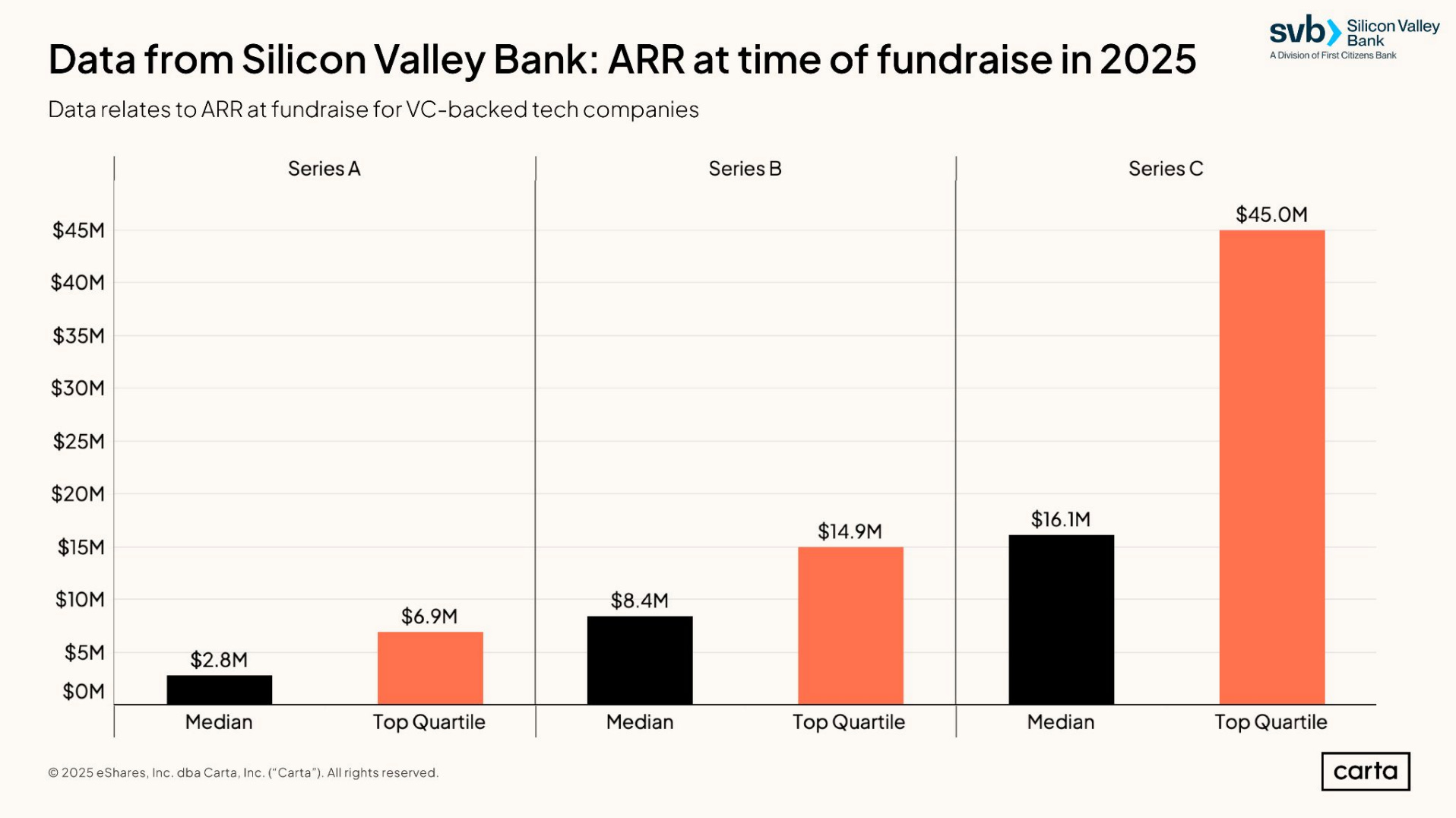
“ARR at the time of fundraise in 2025” - New SVB/Carta data (h/t Peter Walker) on ARR at fundraise in 2025. To translate this to marketplace terms, here is the implied GMV for the $2.8M median Series A ARR:
5% take rate: $56M GMV
10% take rate: $28M GMV
15% take rate: $18.7M GMV
20% take rate: $14M GMV
ARR doesn't exactly translate to net revenue, but I think it's a pretty good benchmark. As always, growth rate matters, too. Here are the implied revenue step-ups at the median:
- Series A → Series B: 3.0x ($2.8M → $8.4M)
- Series B → Series C: 1.9x ($8.4M → $16.1M)
“The internet got rid of middlemen and gave us low take marketplaces. AI is getting rid of marketplaces and giving us (hopefully) even lower take middlemen.” - A provocative observation from Will Quist of Slow Ventures about the evolution of commerce infrastructure. The question isn’t whether AI disrupts marketplaces, but what replaces them. X
“How ChatGPT’s Native Shopping Could Rewrite Digital Commerce” - Viant CEO Tim Vanderhook argues that LLM-powered commerce is “the most accurate thing we have as mankind” for predicting consumer intent, suggesting brands should flip their traditional 70/30 spend ratio to invest more in brand-building for AI visibility rather than demand capture. Search Engine Journal
“A Guide to the Marketplace ‘Plus’ Model” - Based on my interview, CJ Gustafson at Mostly metrics breaks down the strategy of providing either supply or demand something useful as a hook to enter the network. OpenTable started as a digital seating chart before becoming a reservation platform. Outdoorsy built a SaaS that turned clipboards into systems of record. Mostly Metrics
“Leaving RVshare: Reflections from a 7.5-year journey” - Martijn Scheijbeler recaps lessons from scaling an RVshare through COVID, M&A (KKR acquisition), and the efficiency era. Martijn Scheijbeler
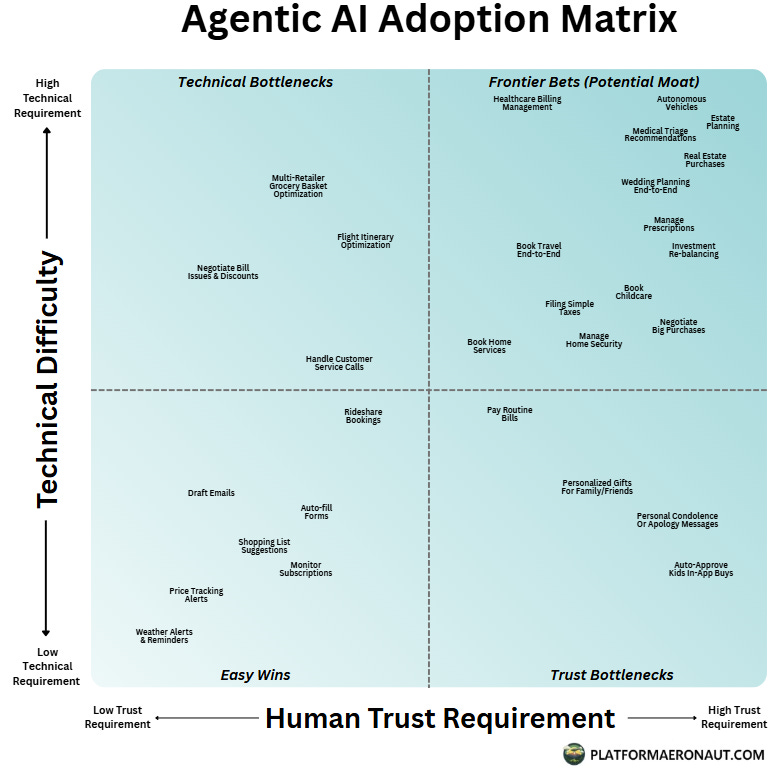
“The Agentic AI Adoption Matrix: Consumer & Travel” - Thomas Reiner created a framework that maps agentic AI solutions by human trust requirements and technical difficulty. The sweet spot insight: “I’d happily let my AI agent cancel a $12.99 Paramount+ subscription, but I’d think twice before letting it buy furniture for my living room.” Travel is the ideal test case because it sits across the entire matrix—highly emotional, high monetary stakes, and a messy ecosystem. Platform Aeronaut
“Diffusion of AI Across Vertical Markets” - Euclid Ventures delivers a comprehensive analysis using Rogers’ “Diffusion of Innovations” and Evans’ “Absorb/Innovate/Disrupt” frameworks. The core insight: vertical markets are lagging not because AI’s potential is low, but because current AI tools are “still mostly contorting itself around existing workflows, rather than reimagining and reshaping them.” The winners will be Vertical Workflow Architects who understand both the lived reality of industries and what it takes to produce venture-scale change. Euclid Insights

“5 New Things We Learned About Marketplaces This Year” - SNAK Venture Partners Perspectives highlights five key insights: (1) Time-to-value is the new kingmaker; AI collapsed onboarding friction; (2) Negative network effects show up sooner with AI-generated content flooding; (3) Synthetic supply is now a real bootstrapping strategy; (4) Reputation layers are becoming portable; (5) Winner-take-most is weakening as AI-driven multi-homing erodes single-platform dominance. Essential reading for understanding how marketplace dynamics are shifting. SNAK VC
“How to Hire a Great CTO (Even If You’re Not a Technologist)” - Spencer Rascoff (CEO of Tinder/Match Group) shares his 10-step playbook for hiring Vinay Kuruvila. Key criteria: someone who hasn’t drifted far from hands-on work, cares about the category, has recent real AI experience, and balances big-company rigor with startup scrappiness. “Technology is moving too fast to lead from the sidelines.” Life at Tinder
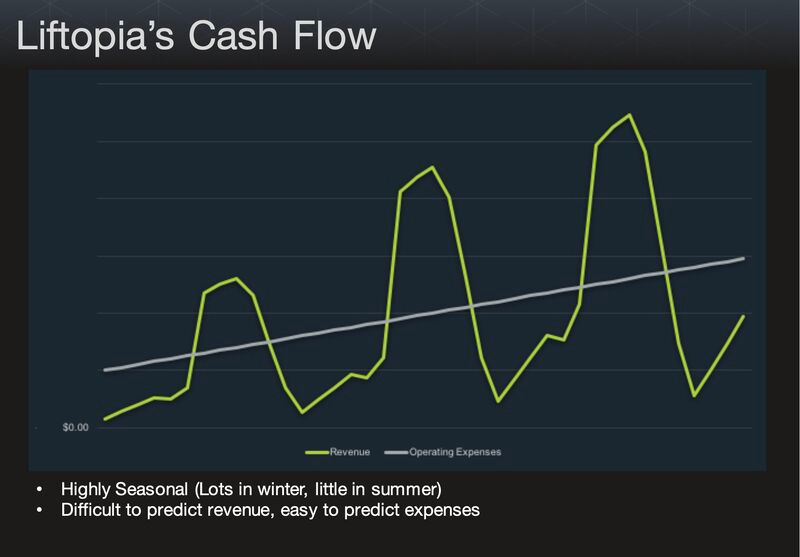
“I thought scale would make dealing with seasonality easier, but it made it harder” - Evan Reece shares a bit about his experience building Liftopia. The majority of the headcount were FTEs needed year-round, but they only generated revenue for 4 months of the year. Essentially, a team that needed to handle $450M-equivalent volume when only handling $150M. What he’d do differently: broaden into counter-seasonal businesses sooner, blend transactional with recurring revenue, and price more appropriately to value. LinkedIn
“Why Uber bears hyper-focused on AVs are missing the bigger picture” - A X thread breaks down Uber’s AV strategy: Q3 ‘25 gross bookings hit nearly $50B (up 21%), and the company is accelerating despite Waymo’s market share growth. AVs are expensive assets that can’t sit idle, but ride-share demand fluctuates wildly. Uber’s hybrid approach, using AVs for predictable base demand and human drivers for peaks, solves the utilization problem. That’s why Waymo partnered with Uber in Austin and Atlanta: instant volume without idle depreciating assets. Add climate limitations (AVs only proven in sunbelt states) and a fragmenting AV market with Avride and other OEMs plugging in, and Uber isn’t getting replaced.


📽 Watch or Listen
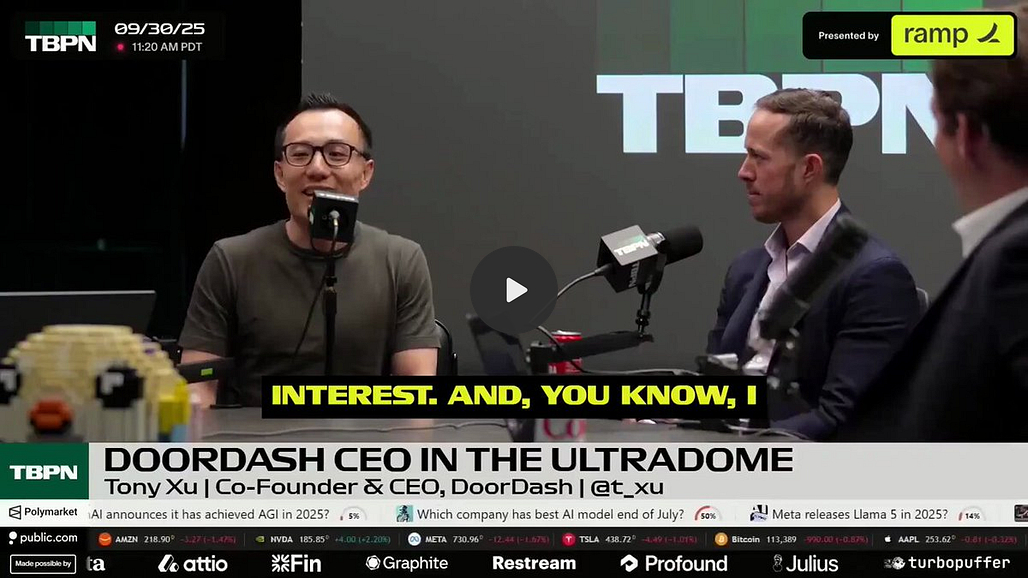
“DoorDash has four huge revenue streams no one knows about” - Everyone thinks of DoorDash as an American food delivery service. They’re wrong. CEO Tony Xu broke down the company’s diversified business, noting that one stream already generates a billion in annualized revenue. The best marketplaces don’t stay one-dimensional. They stack revenue building blocks.

“Nail Your Raise: Luring VCs” - Vinod Khosla delivers a masterclass on effective pitching. Must watch for founders out there fundraising. Khosla Ventures
“What Travis Kalanick Taught Bradley Tusk, & Why He Closed His VC Fund” - On Sourcery with Molly O’Shea, Bradley Tusk discusses what he learned working closely with Travis during Uber’s early regulatory battles and why he returned to an equity-for-services model. Travis was “unusually fast, analytical, and willing to challenge institutions,” which is a mindset that shaped how Uber approached politics and growth. YouTube
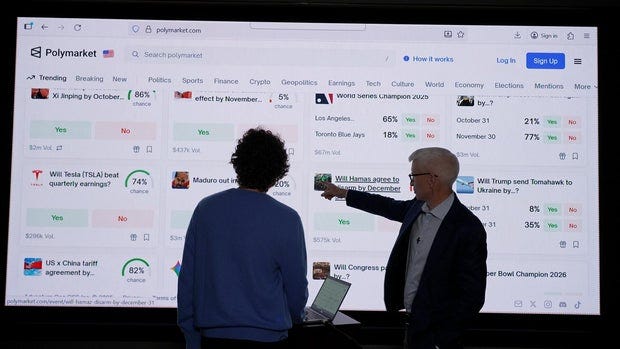
“Polymarket CEO says his prediction market is ‘the most accurate thing we have as mankind right now’” - On 60 Minutes, Shayne Coplan explains how Polymarket works, why it correctly predicted the 2024 election when pollsters called it too close to call, and why the NYSE’s owner just invested $2 billion. CBS News
“Everything Marketplaces Group Chat #203 with Deepak Chhugani (Nuvocargo)” - Deepak Chhugani, Founder & CEO of Nuvocargo, shares how he built a leading cross-border freight platform that’s raised $75M+ from Y Combinator, NFX, and Tiger Global. The conversation covers the pivot that led to Nuvocargo, evolving from tech-enabled brokerage to full platform, sequencing new services, and how they’re leveraging AI agents across operations. Packed with tactical insights on GTM strategies, sales approaches, the “full-stack AI” vs. vertical agent debate, and building defensibility in the age of AI.
Thanks for reading!
That is a wrap for the week! As always, please email me at colin@yonder.vc with any feedback or news I missed. Hot tips are always welcome. Please don’t forget to subscribe and follow me on X and LinkedIn for other great marketplace content. If you’d like to schedule a call, you can find me on expert marketplaces Hubble or Intro.
Power your marketplace with...
Whop Rails – Build a marketplace or platform on our global payment rails.
Built for marketplaces by a marketplace. Platforms are using Whop Rails to get the most competitive pricing, global payouts in ACH, Venmo, PayPal, & stablecoins, payment orchestration, and more! Learn what the hype is about here.
About Me:
Colin is a marketplace geek and the General Partner of Yonder, a pre-seed marketplace fund that invests in marketplaces that create new economies. He has also been a longtime advisor to marketplaces, helping them with product growth, monetization, liquidity optimization, and strategy. Previously, he served as the CPO/CRO at Outdoorsy and has worked at Tripping.com, Ancestry.com, JustAnswer, and the Federal Reserve.
Thanks for this!
Thanks for sharing this Colin!
This read well as a map of coexistence rather than disruption, whereAI marketplaces scaling violently, legacy models like Craigslist still working, and network effects quietly doing what they’ve always done.
It made me think about how many of the breakout cases you highlighted weren’t “better marketplaces,” but marketplaces that unlocked new economic surfaces - evaluation labor, prediction, agent-led workflows, where price sensitivity and norms hadn’t yet hardened.
I’m curious whether you see a point where agents start flattening differentiation across marketplaces, pushing defensibility away from matching and toward who owns reputation, workflow, or capital rails over time?